A worthwhile read. I remember hearing that Pope John Paul II had decline multiple requests from Cardinal Ratzinger to retire years ago. Seems this current, and humble, pope has long been aware of his limitations.
Monday, February 11, 2013

Sunday, February 10, 2013
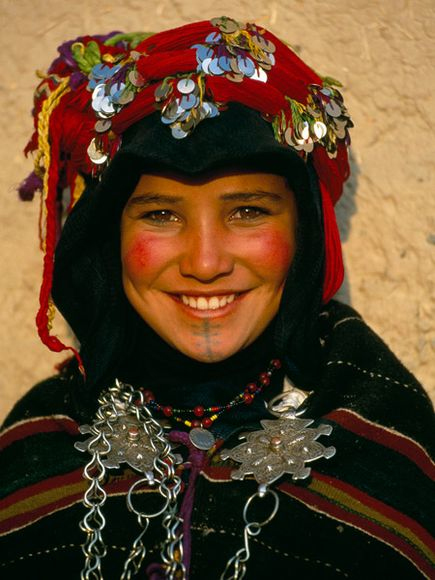
A Celebration of Subjective Beauty
This post comes out of some conversations I had over the past week. It is meant as a response to the argument of those who consider that tattoos or piercings are not a form of cultural or personal expression, and instead claim that "there are in fact objective standards of beauty, you know."

 |
| source |
 |
| source (read more HERE) |
 |
| source |
 |
| source |
 |
| source |
 |
| source |
 |
| source |
 |
| source |
 |
| source |
For more photo montages, visit here for a collection on the theme of global expressions of human beauty, and here for an excellent photo-essay on the diversity of reasons that exist for having a body tattoo.
Saturday, January 26, 2013
Outdoors
Because of my injury, I still can't run but I have been itching to get outdoors. So last week I tried cross-country skiing. It was my first time on skis, period, and I fell plenty and was pretty sore for days from using muscles I don't usually, but it was really fun. We had a beautiful clear day that wasn't too cold and I loved it.
I'm going to look for sales and see if I can get myself a set of skis and boots. We have trails aplenty around here, though I hear from other locals that they have spotted both cougars and bears recently (yikes).


Monday, January 14, 2013
I am suspicious
Mole was content with the little that he owned: one small home, one bed, one pillow, one shelf for books and one cup for tea, along with a taste for simple pleasures, such as spooking birds and peeking into caves. Then one day his friend Emerson visits for tea and plants the seed of dissatisfaction. When they realize there are two of them and only one teacup, Emerson says:
And Mole, instead of feeling secure and confident in his simple life, listens to his friend: "Maybe," thought Mole, "I don't have very much after all," and then he sets off in search of all that Everything he's been missing out on.

Fast-forward in the story to the moment Mole arrives home and has to find a way to get all of the Everything to fit inside his small house. "It wasn't easy," but Mole comforts himself with the thought that "at least I have everything."
And then, what do you think happens next? This part I loved especially:
No more time to peek into caves or spook birds, Mole becomes consumed with sorting and dusting and tidying all his new stuff.
Until the day when Mole sets up a "Free" sign and gives it all away, with the exception of one single teacup, so that he and Emerson can finally enjoy a cuppa, together.
Our minds, too, and not just our homes, have a limited holding capacity. The human mind can only hold so much, and unlike a building it needs rest and nurturing care. It is fragile.
I remain suspicious of the need for "more" everything---more anything. Because having more just might hurt me, and hurt my mind. My children--and I--deserve better than simply a chance to enjoy nice things.
Today I am feeling awfully suspicious. I am suspicious of greed: I suspect that it causes mental damage.
"You need more, Mole."
And Mole, instead of feeling secure and confident in his simple life, listens to his friend: "Maybe," thought Mole, "I don't have very much after all," and then he sets off in search of all that Everything he's been missing out on.
Fast-forward in the story to the moment Mole arrives home and has to find a way to get all of the Everything to fit inside his small house. "It wasn't easy," but Mole comforts himself with the thought that "at least I have everything."
And then, what do you think happens next? This part I loved especially:
"In the days and nights that followed, "everything" took up almost all of Mole's time."
No more time to peek into caves or spook birds, Mole becomes consumed with sorting and dusting and tidying all his new stuff.
Until the day when Mole sets up a "Free" sign and gives it all away, with the exception of one single teacup, so that he and Emerson can finally enjoy a cuppa, together.
*****
It is not too much of a leap to guess that the author's target audience may well be the parent-readers, though I suppose children need the message reinforced as much as possible. "Mommy, that billboard ad about chocolate milk reminds me how much I want chocolate milk" said my [utterly transparent] six-year old. Lordhavemercy.
Beware the lure of storing up material goods, right? It's a good reminder to be guarded around any Emersons who might mean well, but end up inadvertently contributing to an unhealthy preoccupation with things. But think about it: what did Emerson even do? All he did was to give Mole an idea, a thought, and Mole did the rest all on his own.
I remain suspicious of the need for "more" everything---more anything. Because having more just might hurt me, and hurt my mind. My children--and I--deserve better than simply a chance to enjoy nice things.
Today I am feeling awfully suspicious. I am suspicious of greed: I suspect that it causes mental damage.
Tuesday, December 25, 2012
Feast of the Nativity
 |
| source |
"A devout author says that if Jesus Christ had permitted us to ask him to give us the greatest proof of his love, who would have ventured to ask of him that he should become a child like us, that he should clothe himself with all our miseries, and make himself, of all men, the most poor, the most despised, and the most ill-treated?"
St. Alphonsus, THE INCARNATION, BIRTH AND INFANCY OF JESUS CHRIST
Monday, December 17, 2012
Advent
"Prepare a path in our hearts for the coming of your Word, and let his glory be revealed among us.
Bring low the mountains of our pride, and fill up the valleys of our weakness.
Break down the wall of hatred that divides the nations, and make level for mankind the paths to peace."
(-from the first Tuesday of Advent, in Christian Prayer)
 |
| (source) |
Monday, December 10, 2012
St Alphonsus Liguori
A few years ago, I accidentally stumbled across this saint. At that time, I had never heard of him and never read any of his books. In a church library I came across his The Birth and Infancy of Jesus Christ and it looked interesting. As I recall, I ended up holding onto it much longer than I probably should have because I couldn't bear to return it, it was so good.
My parish at that time had until recently been staffed by Redemptorist priests (rather than diocesan ones) and that the statue at the lefthand side of the altar was of St. Alphonsus. He lived until his early nineties and was made a Doctor of the Church in 1871; he was a prolific writer, producing more than a hundred works, though he didn't even beging to write until 1744, when he was almost fifty years old.
At the moment, I am reading two of books, The Practice of the Love of Jesus Christ and a collection of some of his work, in the form of Advent meditations, by Fr. M. Nutt. In the introduction to The Practice, Robert Fenili explains what is unique to St. Alphonsus' writings and what has made him into one of the most widely-read Catholic authors: his ability to write simply and practically about the deepest mysteries of the faith and about prayer in a way accessible to the uneducated of his day (and in the 200 years since!). From the Introduction:
His life was dedicated to bringing a deeper faith to people whose contact with the official Church was minimal and whose lives were beset with superstition, ignorance, and poverty. (...)
As we read his works, beyond the frequent citations from the Bible, we are constantly finding references to the early Doctores Ecclesiae, to the great spiritual writers of the past, and to authors who were popular in the time of Alphonsus. He loved to take a particularly astute or poetic sentiment from these people (usually quoting the Latin original, as was his custom) and weave it by a paraphrase into the fabric of his writing. In this way, he passed on to his largely illiterate audience the wisdom of the Church. His writings are almost an anthology of the refined experience of centuries of Christian saints and mystics.
(pp. x, xiii and xiv)
Here's a question: I can't think of a contemporary writer who does this as well as St. Alphonsus--can you? The closest I have come to finding a modern writer who conveys complex truths in a compelling but relevant style is C.S. Lewis. But Liguori, as far as he can reference the ancient fathers and the saints, too, goes one step further. And he is so readable! It is just remarkable how well he did this (samples to follow, don't worry!).
And if that isn't enough, he loved all the arts, and produced not only poetry but also music. This piece has become an Italian classic and Verdi is said to have claimed that Christmas wouldn't be Christmas without Tu Scendi Dalle Stelle.
At the moment, I am pretty obsessed with the life and work of this saint and I intend to quote him ad nauseum in the next weeks. Now that I've provided you with a brief introduction, at least you'll know who I am talking about.
Saturday, December 8, 2012




Thursday, December 6, 2012
First Impressions
I wrote this over a month ago, having come back from a long weekend in California. What I began as a single post became so long and wandering that I had no choice but to chop it up into parts. However, I hope this will become a longer series but I know better than to make firm announcements about the future of this blog by now so pretend I never said that.
-----
There are folks who exit off the Interstate at our exit and take a look around our little city out here in the Southwestern desert. They are the ones with the wide open eyes and mouths, looking around and meandering slowly down the sidewalks in their Keens or Tevas, or sometimes their black leather, if they are part of the Harley bike crowd. I wish I could still see the place for the first time all over again, like they do.
“Mostly at the Laundromat,” I said.
She asked how often I interacted with Navajo people, and
where. So I explained. See, it’s like this: there are folks with no
running water and no well rights*. So
they drive all the way into town and fill up their water tanks and then haul it
back to the homestead. And while they’re
here, they wash their clothes, too. They
haul the loads out of the backs of pickups in black garbage bags and maybe it’s
been a month since the last visit so there’s plenty to do.
Our rental didn’t have a washer or dryer so that’s how I
know this. (Hi I just met you and now I’m talking about laundry?) But then she
surprised me.
“It’s so beautiful,” she breathed, “this side-by-side
movement—and no one is looking straight at the face of another, but it is still
like a dialogue. They are working
alongside and facing away, but their bodies mirror each other’s movements—a
very necessary, simple household chore—side by side. Like a dance.”
She is wearing a red velvet dress or tunic of some kind over
red Ali Baba pants and red babouches
to “match” (they are different reds) and we are near Malibu
Forgive me if the dance-image struck me as somewhat romantic.
Forgive me if the dance-image struck me as somewhat romantic.
Because in the image in my
mind, in my memory, there was Rez dust everywhere and muddy boots and bulk-buy
powder detergent bags and peddlers of “sterling silver” jewelry and “breakfast
burritos” and it is pretty smelly and noisy.
I know what she means, though: healing violent histories through
creative, therapeutic movement.
Sure. Cool. Why not.
Except that until recently, I had never thought about those
who don’t show up at the
Laundromat. Who, instead of washing
their clothes, wear them out until they either get too frayed or the lice just
get to be too much and then they burn or bury the darn things.
There are folks who exit off the Interstate at our exit and take a look around our little city out here in the Southwestern desert. They are the ones with the wide open eyes and mouths, looking around and meandering slowly down the sidewalks in their Keens or Tevas, or sometimes their black leather, if they are part of the Harley bike crowd. I wish I could still see the place for the first time all over again, like they do.
There’s one now--outside of the coffee shop where I am
sitting and typing. She has stopped her
car and hopped out to pause briefly on the sidewalk, shading her eyes with one
hand and holding up her camera with the other, trying to find the best angle to
shoot the murals that were painted up high above the storefronts.
This corner of the state is not exactly a destination for
tourists; mostly, folks stop for a meal or to fill up their gas tank—only a
couple of minutes or a few hours at most, and then they move on. We don’t have museums or restaurants or
classic Southwestern charm in the style of a place like Santa Fe Grand Canyon . We
have only a tiny, municipal airport which lands tiny, and usually private,
airplanes. The highway is the main way
to get here if you are a visitor. Or the
train. We have an Eastbound one that
stops in the morning, and a Westbound one in the evening. The rest of the day it is freight carriers,
about a hundred of them, whistling their way through loudly so the disoriented
and inebriated will be discouraged from stumbling out onto the tracks as the
cars rattle by.
One of our summer visitors expressed a feeling of relief
when she finally reached the outskirts of town.
She was a return-er, so it wasn’t her first time through, and she was
excited to be back. Having driven
through a good portion of the state in order to get here, she felt that it
seemed as if she hadn’t “really arrived” until she came into our city. This, she said, is the real deal. Unlike any other part of this immense and
varied country of ours. You can’t get
this just anywhere, she said.
She is unlike our other visitors and I wonder if we will
ever have another who says or feels the same thing. Most of them are happy enough to stay for a
few days, and then they are more than happy to leave again. And that’s fine, too. Not everyone takes to this wild west place.
-----
Also this summer, my (very generous) in-laws offered to buy
us a washer and dryer as a housewarming gift.
Maybe I would have declined if it hadn’t been for the twenty-one guests
and three different road trips in two months.
I was exhausted from trying to keep everyone’s t-shirts and linens (not
to mention the camping gear) fresh and laundered. By the end of the summer, I welcomed the
prospect of having even just a single household chore made easier.
But that has meant no more weekly trips to the Laundromat
for me, at least for now. Now I go to
the basement and push some buttons. It is easier, but it is also a little
bittersweet; the Laundromat was one of the only places I could get up close
with Rez residents. It is not like we
talk or anything (many do not speak English, anyway), but at least we were
together in the same space, for once.
It took repeated trips to do my laundry to realize some of
the key ways that a townie’s life is different from rural life in the desert. Access to water means that city-dwelling Navajos will spend their time and resources in ways different from the way of life they might have had on from Reservation. For those who
don’t have water near their homes, there is no choice put to haul it in. I see the tanks in the backs of pickups and I see them haul their
two-weeks’ (or month’s?) worth of dirty laundry in garbage bags that they
unload from out of the trunks of their cars.**
Some of these folks—many—have dirt caked over their boots
and up their shins as they sit back and wait for their loads to finish tumbling
around behind the round glass windows of the machines. It seems hardly worth the effort to scrape the
mud off, and maybe they are down to their last pair of trousers, anyway, so it
is not really an option to give them a good washing.
These folks often stare right back at me and the way I look
is just as strange and foreign to them.
Also, the jeans I thought were so old and grubby suddenly seem very,
very blue. (Oops, there’s my cell phone ringing.)
-----
It has been 16 months since we moved here and, yes, the initial
impressions have faded considerably. That
makes me a little sad. Already, it is
impossible for me to recapture that feeling of surprise at the new and the strange. It is not stale or old, but not quite as
fresh, either.
Even so, Difference is right up there in my face, all the
time and every day, if I am willing to see it.
And not just me, but any outsider who comes through or decides to stop
here for a longer season. You have to
choose to ignore, or dismiss it, if you don’t want to notice anymore.
-----
I first learned about the lice and the family that never
washed their clothes but instead threw them away from reading a book—a memoir
actually.
No doubt it would have taken me much longer to realize that
on my own—that there are people who don’t even have a truck, or the money for
gas, or any other means, to get into town.
So they hitchhike in, or never come at all. Maybe neighbors or relations remember them
and offer to pick up sacks of flour or gallons of cooking oil or whatever
basics they might need.***
I am not proud of it, but until this summer when I read
George P. Lee’s account about growing up desperately poor in a remote part of
the Navajo Nation, I never even thought of the folks I do not ever see at my Laundromat—or any other, either. In George’s family, the kids took “snow
baths” in the winter and looked forward to the summer monsoon rains. Not
only did the rains mean replenished water stores and cleaner bodies, they also meant meat.
The sight and smell of storm clouds had a truly Pavlovian
effect on George and his cousins, and he remembered how they would start to
lick their lips at the thought of all the prairie dogs they would soon be
roasting. The rains would flood the
animals’ burrows and they had no choice but to pop their heads out for
air. All the kids had to do was wait for
the poor creatures, with clubs and bags at the ready.
Ruth Mitchell, in the telling of her childhood, remembers
doing something similar in order to catch prairie dogs: she and one of her
siblings would team up, one of them wielding a club and the other flooding the
holes with water. Had I not read Lee’s
book first, it probably would not have occurred to me that Ruth’s family must
have been somewhat better off, or at least had access to more water than
George’s family did. Even still, her
family still did not own any buckets.****
Going to the Laundromat didn’t exactly provide me with those
kinds of stories, but there is a lot more to learn from being there and I
wonder just how much I am missing out, for the sake of a simple convenience.
-----
So that’s another complaint about the side-by-side,
doing-our-daily-chores-together image.
It is not simply romantic, but also incomplete; it is missing an
essential story plot.
In fact, there is plenty more about Native American history and experience that has
all but disappeared. In the next part in this series, I plan to explore this topic a little more.
* Evidently, water rights in Navajo land are very complicated legal issues. Just because you have a well on or near your homesite does not mean you are allowed to use it. Something to do with the communal and clan ownership of homesteads and the fact that many wells were dug on the federal government's dollar.
** Those infamous "rez cars" that are held together with duct tape and chewing gum and are perpetually stuck in reverse. See it on youtube here, or here.
*** There are no doubt Native Americans who consciously choose a lifestyle that keeps them secluded from the dominant culture and its nosiest members (the ones like me who are too curious and ask too many questions).
**** In her autobiography, Ruth Mitchell describes the process she used as a child whereby they would butcher and skin goats in such a way that their bellies would still be intact and useable as water bags.
* Evidently, water rights in Navajo land are very complicated legal issues. Just because you have a well on or near your homesite does not mean you are allowed to use it. Something to do with the communal and clan ownership of homesteads and the fact that many wells were dug on the federal government's dollar.
** Those infamous "rez cars" that are held together with duct tape and chewing gum and are perpetually stuck in reverse. See it on youtube here, or here.
*** There are no doubt Native Americans who consciously choose a lifestyle that keeps them secluded from the dominant culture and its nosiest members (the ones like me who are too curious and ask too many questions).
**** In her autobiography, Ruth Mitchell describes the process she used as a child whereby they would butcher and skin goats in such a way that their bellies would still be intact and useable as water bags.
Monday, November 26, 2012
Takes
I hesitated when logging in to post. What's my password, again?
Yes, it has been that long.
All my kids were up, out of bed and fully clothed, by 4:49 this morning*. The thing is, my clock said it was 7:06am. Once I realized my mistake, I quickly shooed them back into bed and shut off all the lights and hoped they would be able to get back to sleep. It had certainly been quite an effort to wake them all up and pull them out from under the covers, but sometimes Thursdays were like that so I didn't think much of it.
I don't know what it says about my current lifestyle that I also didn't think much of my own overly sleepy state. I felt more or less as I usually do when I woke up (at about 4:20, though I believed it was 6:40). The night before, I had gone to bed after a long and busy day, anticipating that I would wake up feeling less than rested, so if I was dragging a bit it wasn't really a surprise.
Poor kids. They were headed for an 8-hour school day but my agenda held a coffee shop visit for some blogging time and an afternoon swim with a friend.
Recently,Steve wrote a post inspired by the one word of a Compline
prayer (found at the very end of the post). The line has been running
through my mind ever since.
O Lord our God, unwearied is your love for us.
Which is good to know because some of us around here get pretty wearied sometimes.
-------
Several of my friends and one cousin have recently announced pregnancies. One local friend attempted to draw me in to a conversation about labor and delivery, about which I know very little. She was interested in my so-called "expertise." Problem is, I have never been the kind to research and prep and come out on the other end with strong feelings about natural vs. medicated childbirth or the benefits of Bradley vs. Lamaze. So many variables, so many different body types and personalities and risks and etc. I try not to weigh in during these conversations when they happen around me, if at all possible.
It wasn’t possible for me this time. Physical fitness as security against having to undergo a caesarean section, are you joking?! It’s not like you can exercise your birth canal into being broad enough for your baby’s extra-wide head or something (among the many reasons why surgery is sometimes necessary for a healthy mom and baby). Also, most women are not physically fit in the sense of our 21st centuryU.S.
So yeah, I guess there are some strong feelings in there after all.
Speaking of fitness. I injured myself back in September and can't seem to run any distance at all. That has been rough; I like my outdoor alone time. I have tried to replace trail running with trail riding, but I am just not so good at mountain biking. In town, we have hills everywhere and road biking on a (heavy, hybrid) mountain bike is no picnic, either. But after a little while of doing almost no exercise, I felt that for my winter-wellbeing, I need to get serious again.
My first resolution was to find a way to exercise in some way, each day. Walk, bike, head to the recumbent in our basement--whatever. Netflix documentaries help for the basement workout. I can talk myself into doing them more often if I know I will be learning something interesting.
Some recommendations from my netflix-workouts: We Shall Remain. A six-part PBS series on US History from the perspective of Native Americans. They highlight some of the big "moments" of clash or conflict: the arrival of the Mayflower passengers and the subsequent arrangements/treaties; Tecumseh's resistance movement (and his extreme awesomeness); the Trail of Tears; the controversial Geronimo; the standoff at Wounded Knee in 1973. I learned a lot.
Also under PBS' "American Experience" categor: The Great Famine, about the role of US humanitarian efforts during the 1921 Soviet famine; one on the role of whaling in the birth of the US economy called Into The Deep which was just fascinating; Daughter from Danang which held an unexpected twist more than midway through. And some more that I really don't recommend (because they were not well-made, or whatever).
I also watched some on surfing and marathoning, just to switch it up, and those were not profound but a fun diversion while I sit there pedaling.
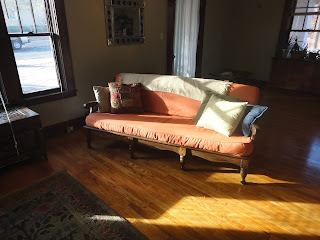
Okay, confession time. I have not acually watched all of those documentaries while working out. Some of them I had on in the background while cutting, pinning and stitching the fabric that finally became my new couch covers. This project was one I completed about a month ago, and it was exceedingly tedious and I am not even proud of the final result, but what the heck. I finally made piped, removable covers for the new foam cushions that are now on the woodframe couch I bought for pennies a mere four years ago! Yay me.
Pennies: my son's outfit to my daughter's First Holy Communion was a brand-spanking-new vest, shirt, slacks and a pin-on tie. For a grand total $0.25.
It was a great find and the only downside is that I am not likely to encounter a bargain like this ever again, in my whole entire lifetime.

My eldest made her First Communion last week (for whatever reason, in our parish they do these in the Fall and not the Spring). It was a beautiful Mass and she said she felt ready and only a little nervous. About 50 people came over for a pot-luck afterwards and she said she loved all the attention.
We had been preparing for this event for so long and had so many talks but until I was there in the pew, I had not realized that she was entering into full communion with the Catholic Church exactly one decade after me.
But I didn't get to wear one of those lovely white gowns.

*this actually happened a few weeks ago, but I did not got around to publishing this post until now.
Yes, it has been that long.
--------
All my kids were up, out of bed and fully clothed, by 4:49 this morning*. The thing is, my clock said it was 7:06am. Once I realized my mistake, I quickly shooed them back into bed and shut off all the lights and hoped they would be able to get back to sleep. It had certainly been quite an effort to wake them all up and pull them out from under the covers, but sometimes Thursdays were like that so I didn't think much of it.
I don't know what it says about my current lifestyle that I also didn't think much of my own overly sleepy state. I felt more or less as I usually do when I woke up (at about 4:20, though I believed it was 6:40). The night before, I had gone to bed after a long and busy day, anticipating that I would wake up feeling less than rested, so if I was dragging a bit it wasn't really a surprise.
Poor kids. They were headed for an 8-hour school day but my agenda held a coffee shop visit for some blogging time and an afternoon swim with a friend.
-------
The great thing about having all three kids at school all day and no day job is that you get to go through an early mid-life identity crisis, yay! The only good thing about this is that once I come out on the other end of this thing...I will be on the other end of it.
I suppose it is also good that the husband and I are not simultaneously enduring this because I can only imagine how rough that would be.
-------
O Lord our God, unwearied is your love for us.
Which is good to know because some of us around here get pretty wearied sometimes.
Several of my friends and one cousin have recently announced pregnancies. One local friend attempted to draw me in to a conversation about labor and delivery, about which I know very little. She was interested in my so-called "expertise." Problem is, I have never been the kind to research and prep and come out on the other end with strong feelings about natural vs. medicated childbirth or the benefits of Bradley vs. Lamaze. So many variables, so many different body types and personalities and risks and etc. I try not to weigh in during these conversations when they happen around me, if at all possible.
It wasn’t possible for me this time. Physical fitness as security against having to undergo a caesarean section, are you joking?! It’s not like you can exercise your birth canal into being broad enough for your baby’s extra-wide head or something (among the many reasons why surgery is sometimes necessary for a healthy mom and baby). Also, most women are not physically fit in the sense of our 21st century
So yeah, I guess there are some strong feelings in there after all.
-------
Speaking of fitness. I injured myself back in September and can't seem to run any distance at all. That has been rough; I like my outdoor alone time. I have tried to replace trail running with trail riding, but I am just not so good at mountain biking. In town, we have hills everywhere and road biking on a (heavy, hybrid) mountain bike is no picnic, either. But after a little while of doing almost no exercise, I felt that for my winter-wellbeing, I need to get serious again.
My first resolution was to find a way to exercise in some way, each day. Walk, bike, head to the recumbent in our basement--whatever. Netflix documentaries help for the basement workout. I can talk myself into doing them more often if I know I will be learning something interesting.
-------
Some recommendations from my netflix-workouts: We Shall Remain. A six-part PBS series on US History from the perspective of Native Americans. They highlight some of the big "moments" of clash or conflict: the arrival of the Mayflower passengers and the subsequent arrangements/treaties; Tecumseh's resistance movement (and his extreme awesomeness); the Trail of Tears; the controversial Geronimo; the standoff at Wounded Knee in 1973. I learned a lot.
I also watched some on surfing and marathoning, just to switch it up, and those were not profound but a fun diversion while I sit there pedaling.
-------
Okay, confession time. I have not acually watched all of those documentaries while working out. Some of them I had on in the background while cutting, pinning and stitching the fabric that finally became my new couch covers. This project was one I completed about a month ago, and it was exceedingly tedious and I am not even proud of the final result, but what the heck. I finally made piped, removable covers for the new foam cushions that are now on the woodframe couch I bought for pennies a mere four years ago! Yay me.

------
Pennies: my son's outfit to my daughter's First Holy Communion was a brand-spanking-new vest, shirt, slacks and a pin-on tie. For a grand total $0.25.
It was a great find and the only downside is that I am not likely to encounter a bargain like this ever again, in my whole entire lifetime.
------

My eldest made her First Communion last week (for whatever reason, in our parish they do these in the Fall and not the Spring). It was a beautiful Mass and she said she felt ready and only a little nervous. About 50 people came over for a pot-luck afterwards and she said she loved all the attention.
We had been preparing for this event for so long and had so many talks but until I was there in the pew, I had not realized that she was entering into full communion with the Catholic Church exactly one decade after me.
But I didn't get to wear one of those lovely white gowns.

*this actually happened a few weeks ago, but I did not got around to publishing this post until now.
Tuesday, August 28, 2012
County poverty
I came across this map showing the poorest states and counties in the US. I clicked around on the dark red counties around the nation and there were few (only in Appalachia, the Dakotas and a couple of deep south states) that rival my current home state. I guess I am not terribly surprised, considering that apparently 1/3 of the children in my county do not have running water at home.
And what is the poorest state in the US right now? That was news to me: Mississippi.
And what is the poorest state in the US right now? That was news to me: Mississippi.
Saturday, June 23, 2012
"If you feel loved, you can do anything"
For once, I am grateful for a link I followed on Facebook (although the article's title is a little misleading). It is such a short article, but there is a lot in it.
Friday, April 13, 2012
quick takes
1.
It's been awhile since I've done Friday Takes, and today seemed like a good day until I read Jen's. A scorpion--on her couch--stung her son--ON HIS FACE.
I can't compete with that level of madness.
2.
And then I remembered: it's a "quick takes," not a competition so here I am.
Speaking of feeling competitive, within my running crowd friends I remain the slowest and worst in every way. Sometimes that doesn't bother me, and sometimes it does. I wish it never did and that I didn't care. I still run anyway.
3.
Over the last couple of months, I have attempted a few book & film review posts for this blog and so far they've gone nowhere. So here is a short list, in case I never get around to it:
-good documentaries that I recommend: Reel Injun on portrayals and perceptions of Native Americans within the film industry. This was good and very worthwhile, if not excellent.
Sons of Perdition on Utah's "lost boys" who either run away or are exiled from Warren Jeffs' Fundamentalist Latter Day Saints community. It has a hopeful tone and message, despite the sadness of the topic. It is really excellent on a lot of levels and I'd love to sit down and write more about it one of these days.
-crazy depressing documentaries that I don't recommend, but are still well-made: The Wild and Wonderful Whites about the lawless White family of West Virginia. That movie, and the family it is about, are both insane.
A Film Unfinished is a documentary about a Nazi propaganda film that was made in the Warsaw ghetto in the early 40's. They staged scenes, choosing from among the better-off and better-off among the Jewish population in the ghetto, in order to depict a life of comfort and ease. They actually were trying to convince people that the Warsaw Jews were living in a utopia. However, the propagandists also filmed the streets and captured the real story, and so the documentary makers (almost 70 years later) juxtaposed that footage with interviews of survivors and transcripts of depositions with one of the actual cameramen.
-currently reading: A Mormon Mother, by Annie Clark Tanner. This is an autobiography written in 1941 by a woman who became one of the plural wives of a prominent Mormon and university professor in the late 1800's. She originally wrote it for the sake of her children and grandchildren but it is so well-written and so fascinating that it was eventually published and distributed more broadly. I am totally hooked.
Geek Love. A friend recommended this one for its strangeness and it is definitely strange but I like it.
4.
We are buying a house! This is a first for us, but we found the right place in the right location for the right price so we're going for it. It's not fancy (not much in this town is), but it has a lot of character AND...a guestroom! Hint, hint.
5.
Pardon me, but I'm going to talk about the weather. Springtime here has two extremes: sunny and pleasant, and bitter cold and windy. It gets really, really windy and since we're in the desert and all, that means dust and dust and more dust. I will try to get some photos, but I'm not making any promises. I don't usually think of the camera when I'm out there, I just try to survive and not swallow too much dirt and leaves.
6.
Tomorrow, Jeremy is participating in a local mountain bike event. It's an all-day race and he is on a two-man team which means they will alternate all day long, in 1.5 hour shifts, for twelve hours. The forecast is not good. Last year they had snow the day of the race and tomorrow is supposed to be cold, windy, rainy and snowy with a high of 39.
Jeremy expects he'll be ready for bed at 8:00pm.
7.
Last but not least, a quote from my five-year old son that wasn't fit for the family blog.
He was calling to me from the bathroom: "MO-MMEEE! I tried to get it in the potty but I accidentally peed in my eye!"
Sunday, April 8, 2012
Vigil
Last night I attended the Easter Vigil at my parish. This is the first year that my parish church also happens to be the cathedral for the diocese and so the bishop was the celebrant. It is a very beautiful building, and especially so at night and with candles, though after the rest of the Holy Week liturgies, it's a test of stamina to make it through the three hours (especially so late at night!).
I don't know for sure because I haven't been keeping close track, but maybe I've attended a dozen or so Vigils, but not always Catholic ones. And about half of those were before I made my First Communion because once I went, I couldn't wait to go back the next year. The very first Easter Vigil I attended was at an Orthodox church in Morocco, in '96 or so, where I was a guest of a Romanian friend. Afterwards we had a feast that lasted until dawn and by the end, in my delirium, I became convinced that I could understand Romanian!
One of the earliest portions of the service is the Exultet, usually sung by the deacon. Apparently this prayer dates back to the fifth or sixth century. "[H]ere the language of the liturgy rises into heights to which it is hard to find a parallel in Christian literature. We are drawn out of cold dogmatic statement into the warmth of the deepest mysticism." That is my favorite part of the evening, and I don't even understand it all. This helped, though. It is the transcript of the Pope's homily from last night and worth a read.
Happy Easter, everyone!
I don't know for sure because I haven't been keeping close track, but maybe I've attended a dozen or so Vigils, but not always Catholic ones. And about half of those were before I made my First Communion because once I went, I couldn't wait to go back the next year. The very first Easter Vigil I attended was at an Orthodox church in Morocco, in '96 or so, where I was a guest of a Romanian friend. Afterwards we had a feast that lasted until dawn and by the end, in my delirium, I became convinced that I could understand Romanian!
One of the earliest portions of the service is the Exultet, usually sung by the deacon. Apparently this prayer dates back to the fifth or sixth century. "[H]ere the language of the liturgy rises into heights to which it is hard to find a parallel in Christian literature. We are drawn out of cold dogmatic statement into the warmth of the deepest mysticism." That is my favorite part of the evening, and I don't even understand it all. This helped, though. It is the transcript of the Pope's homily from last night and worth a read.
Happy Easter, everyone!
Subscribe to:
Posts (Atom)